

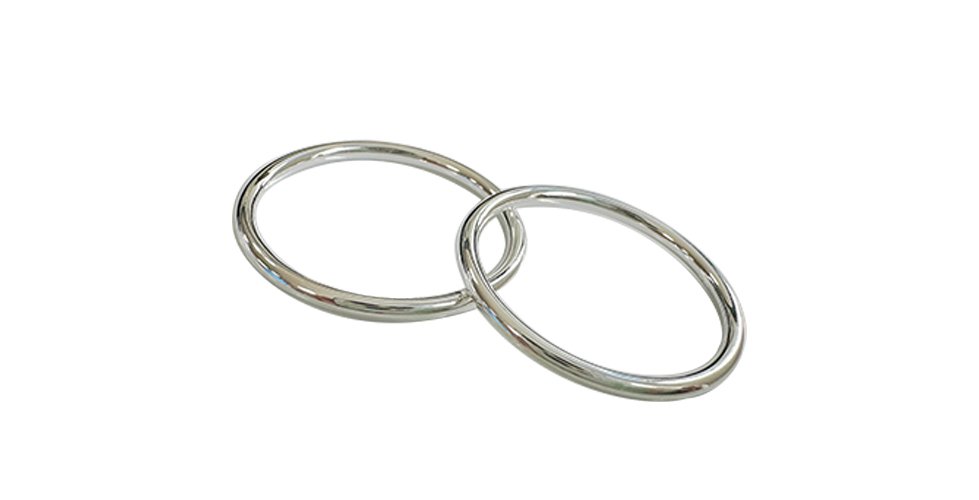
Metal O ring is widely used as static sealing element in high-vacuum systems, pressure vessels, and extreme industrial environments where elastomer seals cannot survive. Typical applications include aerospace assemblies, nuclear equipment, high-temperature reactors, and vacuum chambers. While metal O-rings provide excellent resistance to temperature, pressure, and chemical attack, their sealing performance is strongly influenced by one critical factor: elastic recovery.
Compared with elastomeric seals, metal O-rings exhibit a much lower elastic recovery rate. This limitation becomes even more pronounced under prolonged exposure to high temperature, radiation, or cyclic loading. As elastic recovery decreases, the ability of the seal to maintain contact pressure against the mating surfaces is reduced, which may eventually lead to leakage. For long-term service in extreme environments, improving elastic recovery is therefore a key design objective for metal O ring.
The Role of Elastic Recovery in Metal O Ring Sealing
Elastic recovery refers to the ability of a metal O-ring to return toward its original shape after being compressed during installation. This spring-back behavior is essential for maintaining sealing stress over time. In practical applications, elastic recovery compensates for:
Thermal expansion and contraction of flanges
Surface irregularities and tolerances
Relaxation and creep of the sealing system
Minor movements caused by pressure fluctuations
When elastic recovery is insufficient, even a precisely machined groove and flange may lose sealing integrity during long-term operation. For this reason, elastic recovery is often considered one of the most important performance indicators for metal O ring used in demanding conditions.
Limitations of Conventional Metal O Ring Designs
Traditional metal O ring typically use a simple circular cross-section manufactured from stainless steel or nickel-based alloys. While this geometry offers excellent strength and manufacturability, it is not optimized for elastic deformation.
Under compression, a conventional metal O ring tends to deform plastically at the contact zones while storing only a limited amount of elastic energy. As operating temperature increases or as the seal experiences repeated loading and unloading, the recoverable elastic deformation gradually decreases. Over time, this loss of elastic recovery reduces the contact pressure at the sealing interface.
To overcome this limitation, many sealing solutions rely on auxiliary components such as internal springs. However, spring-assisted designs add complexity, increase cost, and may introduce additional failure modes under extreme conditions. An alternative approach is to improve elastic recovery directly through geometrical optimization of the metal O ring itself.
Structural Optimization as a Design Strategy
One effective way to enhance elastic recovery is to modify the internal geometry of the metal O ring while maintaining the same material and overall volume. From a mechanical perspective, thinner and more flexible regions within the cross-section can store more elastic energy than thick, rigid sections.
By carefully reshaping the internal boundaries of the O-ring, it is possible to achieve:
Higher elastic deformation under the same seating load
Improved elastic energy storage during compression
More uniform stress distribution across the cross-section
Reduced risk of localized plastic deformation
Rather than relying on trial-and-error design, modern engineering approaches use numerical simulation and optimization techniques to identify geometries that maximize elastic performance while remaining manufacturable.
Shape Optimization and Elastic Energy Considerations
In optimized metal O ring designs, elastic energy becomes an important evaluation criterion in addition to elastic recovery. Elastic energy represents the amount of recoverable mechanical work stored in the seal during compression. A higher elastic energy value generally indicates a stronger ability to maintain sealing stress over time.
Optimized cross-sections often feature subtle geometric features on the inner boundary of the ring. These features encourage controlled bending and deformation during compression, allowing the seal to behave more like a spring without sacrificing structural integrity. As a result, the elastic stress distribution tends to form a more continuous band across the mid-thickness of the ring, rather than concentrating at sharp contact points.
This improved stress distribution not only enhances elastic recovery but also reduces the likelihood of crack initiation or long-term material damage under cyclic loading.
Manufacturing and Practical Design Considerations
While structural optimization offers clear performance benefits, manufacturability remains a critical constraint. Metal O ring must be produced with smooth, continuous geometries that can be reliably formed, machined, or welded. Sharp transitions, excessive curvature, or complex internal features may improve elastic behavior in theory but create challenges in real-world production.
For this reason, practical optimized designs focus on smooth internal profiles that balance mechanical performance with manufacturing feasibility. Advanced forming techniques and precision machining make it possible to produce optimized metal O ring that retain consistent quality and dimensional accuracy.
Material selection also plays a crucial role. Nickel-based alloys such as Inconel, when combined with optimized geometries, provide metal seals with excellent elastic recovery and stress distribution. Depending on the specific operating conditions, engineers may choose between standard metal O-rings, reinforced metal C rings, or hollow metal O ring designs to achieve the desired sealing performance.
Benefits for Long-Term and Extreme Applications
Improving elastic recovery through structural design optimization offers several advantages for long-term sealing applications:
Enhanced sealing reliability under high temperature and pressure
Improved resistance to performance degradation over time
Reduced dependence on auxiliary spring components
Better tolerance to thermal cycling and dimensional changes
Increased service life in radiation or corrosive environments
These benefits are particularly valuable in applications where maintenance access is limited or where seal replacement is costly and time-consuming.
Applications Requiring Enhanced Elastic Recovery
Improved elastic recovery is particularly valuable in applications such as:
Vacuum systems with long service intervals
Pressure vessels exposed to thermal cycling
Nuclear and radiation-sensitive environments
Aerospace components requiring high reliability
Industrial equipment operating under extreme pressure and temperature
In these applications, even minor improvements in elastic recovery can significantly extend maintenance intervals and reduce leakage risk.
Conclusion: Engineering Better Metal O Ring Sealing Solutions
Metal O ring remain indispensable for sealing in extreme environments, but their long-term performance depends heavily on elastic recovery and stress distribution. By optimizing structural geometry—particularly the internal contour—it is possible to significantly enhance elastic recovery and stored elastic energy without adding springs or increasing material volume.
Such design-driven improvements offer a practical path toward longer service life, improved reliability, and reduced leakage risk in demanding applications.
As a sealing solutions provider, QZSEALS supports customers not only with high-quality metal O ring, but also with engineering expertise to select and optimize sealing designs based on specific operating conditions, including pressure, temperature, media compatibility, and service life requirements. By combining material knowledge with structural optimization, we help deliver reliable sealing solutions tailored to real-world applications.