

How to Select the Right Size Seal Based on Seal Groove Design
In our experience manufacturing millions of sealing components at QZSEALS, the vast majority of so-called “material failures” are, in reality, seal sizing failures. A seal that is too small will leak due to insufficient compression; a seal that is too large will suffer from extrusion and premature wear.
How to select the right size seal is not simply a matter of measuring an old, worn-out part and looking for a replacement with similar dimensions. For engineers and buyers working with an experienced industrial O-ring supplier, achieving reliable sealing performance requires a reverse-engineering approach that begins with the hardware itself—specifically the seal groove design (gland) where the seal is installed. By analyzing the groove geometry, clearances, and functional requirements of the application, proper custom seal sizing can be achieved rather than relying on assumptions based on deformed or aged seals. This guide outlines the precise steps our engineering team follows to determine the correct seal dimensions and tolerances for both standard operating conditions and critical, high-performance applications.
Step 1: Don’t Trust the Old Seal
One of the most common mistakes in seal replacement is measuring O-rings or seals that have already been in service. An O-ring or hydraulic seal that has been in service has likely suffered from compression set (permanent deformation) or chemical swell. Measuring a deformed seal will give you incorrect data.
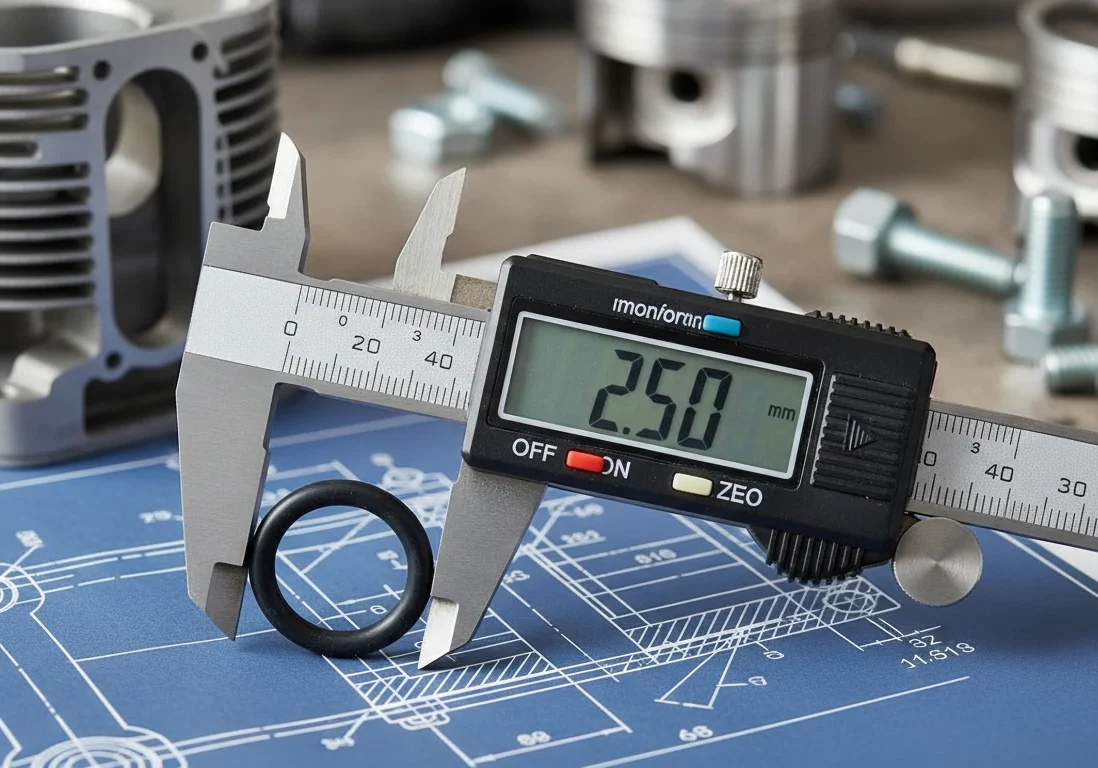
Instead, you must measure the metal hardware according to established O-ring groove design guidelines. Accurate evaluation of the seal gland dimensions is essential for reliable sealing performance. You need three critical dimensions:
- The Groove Diameter: The inner or outer diameter of the channel.
- The Groove Width: The space available for the seal to expand.
- The Clearance Gap: The distance between the mating surfaces.
Step 2: Determine the Application Type (Static vs. Dynamic)
Seal sizing rules change dramatically depending on whether the application is static or dynamic. Understanding rod vs piston seal sizing is essential before calculating compression or selecting cross-sections.
Piston Sealing (Outer Sealing)
For a piston seal, the seal sits in a groove on the moving piston and seals against the cylinder bore. The critical dimension here is the Outer Diameter (OD). The seal needs to be slightly larger than the bore to create interference. For heavy-duty applications, we recommend specialized piston seals rather than simple O-rings.
Rod Sealing (Inner Sealing)
Here, the seal sits in the housing and seals against a moving rod. The critical dimension is the Inner Diameter (ID). The ID of the seal should typically be slightly smaller than the rod diameter to ensure a tight grip. See our range of rod seals for specific sizing charts.
Step 3: Calculating the “Squeeze” (Compression Ratio)
Every elastomeric seal works by elastic deformation. The controlled deformation applied during installation is known as the compression ratio, and accurate calculation of compression ratio is central to seal performance.
- Static Applications: We aim for a high compression (20% to 30%). This ensures a robust seal for parts that do not move, such as flanges using non-asbestos gaskets.
- Dynamic Applications: We aim for lower compression (10% to 20%). Too much squeeze generates friction and heat, destroying the seal.
If you are using standard O-rings, you must balance the Cross-Section (CS) diameter against the groove depth. You can view standard CS options in our O-rings category.
Step 4: Accounting for Thermal Expansion and Swell
Sizing is not just about geometry; it is about physics. Rubber expands when heated. If you select a seal that fills 100% of the groove volume at room temperature, it will fail when the machine heats up because the rubber has nowhere to go.
The Golden Rule: The seal volume should never exceed 85% to 90% of the groove volume. This leaves room for thermal expansion.
For high-temperature environments, standard sizing calculations might need adjustment based on the material. For example, PTFE O-rings are much harder and less elastic than rubber, requiring different groove calculations compared to FDA silicone O-rings.
Step 5: Managing the Extrusion Gap
If the clearance between metal components is too large, system pressure can force the seal material into the gap, leading to extrusion and rapid failure. Controlling the O-ring extrusion gap is therefore critical in high-pressure applications.
To prevent extrusion, you have three professional options:
- Use a Back-up Ring: If the groove is wide enough, install a back-up ring to close the gap.
- Increase Hardness: Select a harder compound. For example, switch from a standard 70A durometer to a NBR 90A O-ring or HNBR 90A O-ring.
Step 6: When Standard Sizes Don’t Fit
Often, we encounter older machinery or custom fabrication where standard AS568 or ISO 3601 sizes simply do not fit. You have two professional options:
1. Custom Vulcanized Rings
For large static applications (like tank lids), we can manufacture a seal to any diameter using precision cord stock. We cut the material to the exact required circumference and vulcanize the joint. This is a cost-effective way to get a perfect fit without tooling costs. Explore our O-ring cord options.
2. Custom Molded Parts
If the cross-section is unique or the geometry is complex (like a custom L2M oil seal), we create a custom mold. QZSEALS specializes in customized rubber products. Our team calculates the shrinkage rate of the material to ensure the final molded part matches your hardware designs perfectly.
Summary: The Checklist for Sizing Success
To ensure you select the right size seal every time, follow this checklist from our engineering department:
- Measure the hardware groove, not the old seal.
- Calculate the “Squeeze”: 10-20% for dynamic, 20-30% for static.
- Ensure the seal stretch (on the ID) does not exceed 5%.
- Verify that the seal volume fills no more than 85% of the groove.
- Check the extrusion gap against the system pressure.
At QZSEALS, as a professional sealing solutions manufacturer, we understand that a difference of 0.1mm can determine the success or failure of a project. Whether you need standard oil seals or complex spring energized seals, mastering seal dimension guides, groove design, and compression ratio calculations is the first step toward long-term reliability.