

Introduction: The Invisible Guardian of Sanitary Integrity
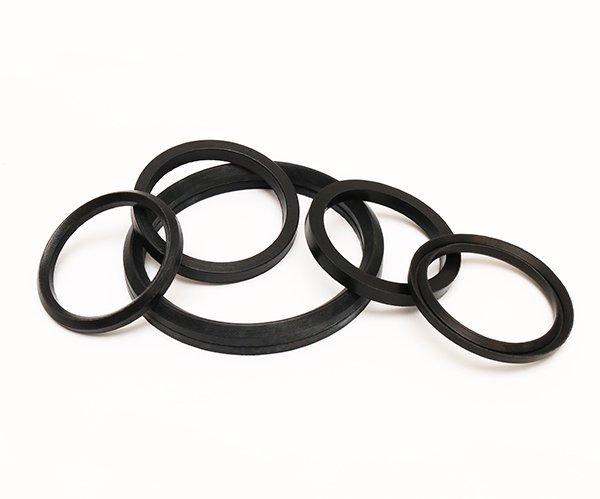
In the complex architecture of modern processing plants, the Tri-Clamp connection is often viewed as a standard utility. However, for maintenance engineers in the biopharmaceutical, brewery, and fine chemical industries, the choice of a sanitary gasket is a critical design discipline. A Tri-Clamp gasket (also known as a tri-clover gasket or ferrule gasket) is not just a filler; it is the primary barrier that ensures sanitary piping system sealing solutions for pumps, filters, and high-purity fittings.
Choosing the incorrect material for your system can lead to catastrophic consequences: from microbial contamination in a fermentation batch to hazardous chemical leaks in a reactor line. This guide, provided by the engineering team at QZSEALS, serves as a comprehensive blueprint for how to select Tri-Clamp gasket material, moving beyond simple catalog numbers to a deep understanding of material science and mechanical reliability.
Phase 1: Understanding the Tri-Clamp Sealing Mechanism
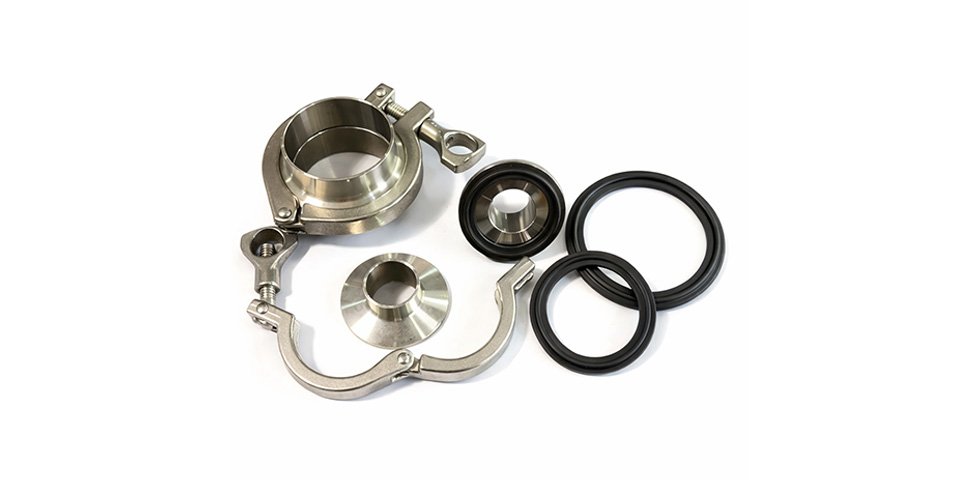
To master how to select Tri-Clamp gasket material, one must first understand how a Tri-Clamp joint functions. Unlike bolted flanges, Tri-clamp gasket function as a self-centering sealing element between two inox steel fittings called ferrules.
The seal is achieved through a collar (clamp) that applies uniform radial pressure, which is converted into axial compression on the gasket. At QZSEALS, our gaskets are engineered with a semi-cylindrical protuberance on both surfaces. This design ensures that the gasket fits perfectly into the groove of the ferrules, providing mechanical stability and preventing the seal from shifting under high-vibration or thermal cycling sealing challenges, making them the ideal sanitary piping system sealing solutions.
Phase 2: The Material Pyramid – A Deep Dive into Performance
Different Tri-Clamp gasket materials offer vastly different performance envelopes. As a source manufacturer of industrial seals, we categorize these materials based on their thermal, chemical, and mechanical resilience.
1. Silicone Tri-Clamp Gasket: The Standard for Biopharma
Silicone sanitary gaskets are widely celebrated in the food, beverage, and pharmaceutical sectors. Their primary strength lies in their high-purity hygienic properties.
Engineering Features: Our silicone compound offers a smooth and delicate surface finish (Ra ≤ 0.4 μm), which is essential for preventing protein binding or bacterial growth. It possesses excellent elasticity and a low friction coefficient, ensuring it doesn’t stick to the stainless steel ferrules during frequent disassembly.
Regulatory Assurance: Our silicone products are manufactured as FDA compliant sanitary gaskets, ensuring they meet the strictest safety and health standards.
Performance Range: It maintains its structural integrity from -60°C to 200°C.
Best Use Case: Ideal for brewery and beverage triclamp systems where flexibility and a “clean” seal are paramount.
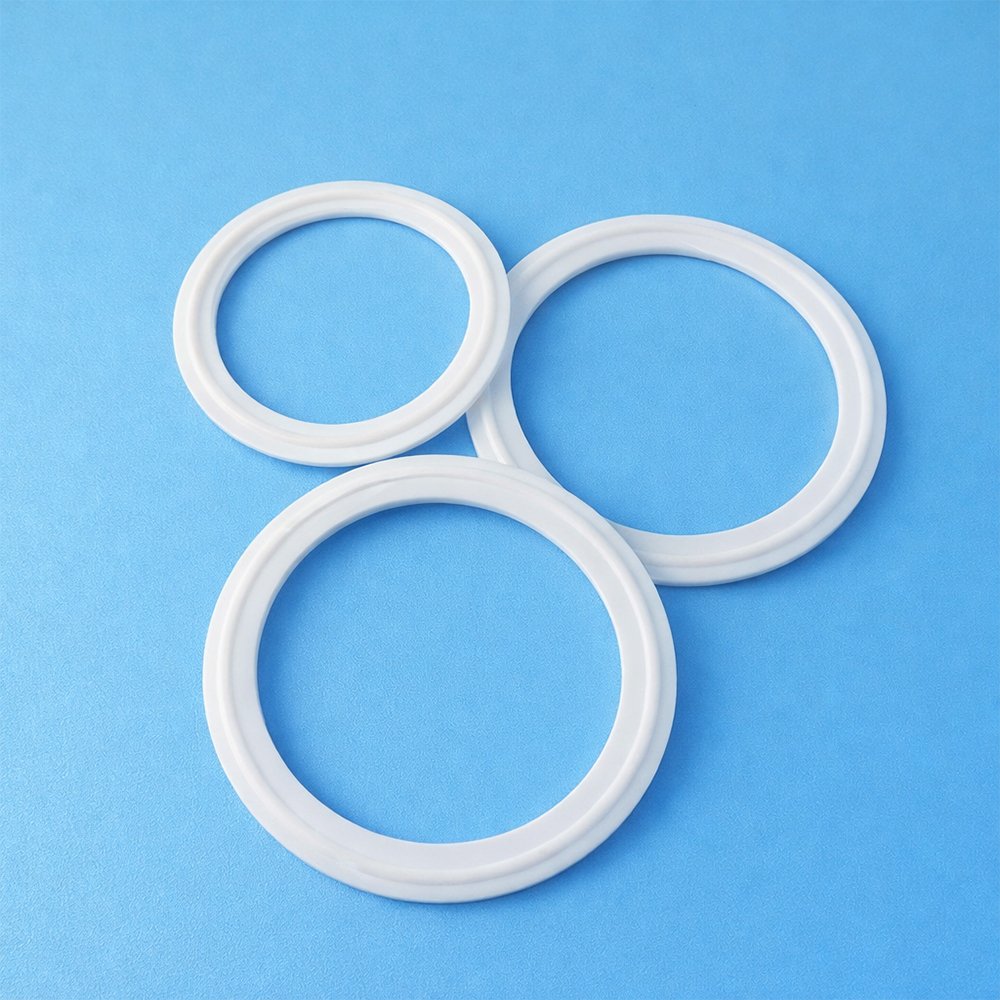
2. PTFE (Teflon) Tri-Clamp Gasket: The Chemical Fortress
For processes involving aggressive solvents or high-purity chemicals, PTFE Tri-Clamp gaskets for corrosive media are the apex solution.
Engineering Features: We use 100% virgin PTFE material with zero recycled fillers. PTFE is virtually inert to almost all industrial chemicals. It is also a “harder” seal, which makes it excellent for applications where low friction sealing and high-pressure resistance are required.
The Paradox of PTFE: While PTFE offers near-universal chemical resistance, it is a thermoplastic with poor “memory” (creep). To solve this, QZSEALS offers PTFE encapsulated gaskets, which combine a PTFE jacket with an elastomeric core to provide both chemical immunity and spring-back resilience.
Performance Range: Exceptional stability from cryogenic temperatures (-196°C) to extreme high temperatures (280°C).
3. FKM (Viton) Tri-Clamp Gasket: Built for Hydrocarbons
When your piping system handles oils, fuels, or petroleum-based fluids, FKM gaskets (often referred to by the brand name Viton™) are mandatory, often serving as reliable high-temperature Tri-Clamp seals.
Engineering Features: FKM is specifically engineered for hydrocarbon resistance. It maintains its mechanical toughness and aging resistance even when submerged in aggressive oils at high temperatures.
Performance Range: Reliable performance up to +240°C, while retaining elasticity down to -25°C.
Best Use Case: Used extensively in industrial oil-based media pipelines and high-temperature fatty acid processing.
4. EPDM Tri-Clamp Gasket: The Steam & Water Specialist
EPDM sanitary gaskets are the most cost-effective sealing solution for water-based processing and steam sterilization cycles.
Engineering Features: EPDM offers outstanding resistance to hot water, steam, and polar solvents. It is the go-to material for Clean-in-Place (CIP) and Sterilize-in-Place (SIP) procedures using steam.
Performance Range: Effective from -45°C to +150°C.
Best Use Case: General industrial water systems, outdoor weathering applications, and steam-laden pharmaceutical lines.
Phase 3: Selection Matrix & Comparative Analysis
To assist in your seal selection process and find the best sanitary piping system sealing solutions, refer to the following technical comparison table developed by our laboratory:
| Material | Temperature Range | Chemical Resistance | Steam Resistance | Main Advantage |
| Silicone | -60°C to 200°C | Moderate | Good | Highest flexibility & purity |
| PTFE | -196°C to 280°C | Excellent (Universal) | Excellent | Lowest friction, no aging |
| FKM (Viton) | -25°C to 240°C | Excellent (Oils/Fuels) | Moderate | Best for petroleum media |
| EPDM | -45°C to 150°C | Good (Acids/Alkalis) | Superior | Best for steam and cost |
Phase 4: Critical Hardware Integration & Failure Prevention
A successful Tri-Clamp connection is a system, not just a part. To ensure long-term sealing reliability, engineers must consider the following integration factors:
Hardware Surface Finish: The inox steel ferrules must have a controlled surface finish. A roughness that is too high will abrade the gasket, while one that is too smooth might cause the gasket to slip under high pressure.
Extrusion Gap Control: High-pressure applications require a precise fit between the gasket and the ferrule groove. If the gap is too large, the material will undergo seal extrusion, leading to a sudden leak.
Chemical Compatibility Audit: Always check the compatibility of the gasket with your Clean-in-Place (CIP) chemicals. A gasket that is compatible with your product might still be destroyed by an aggressive 2% nitric acid cleaning cycle.
Installation Torque: Unlike bolted joints, Tri-Clamps rely on the tension of the clamp. Over-tightening can cause the gasket to “protrude” into the pipe ID, creating a microbial trap where bacteria can thrive.
The QZSEALS Difference: From Source Factory to Your System
When you source from QZSEALS, you are not buying from a trading company; you are partnering with a high-precision sealing manufacturer. Our commitment to industrial machine reliability is baked into every gasket we produce.
Why Engineers Choose QZSEALS:
Source Manufacturer Authority: We control the entire O-ring and gasket manufacturing process, from raw material mixing to cryogenic flash trimming. This ensures that every Tri-Clamp gasket meets the tightest dimensional tolerances.
Material Certification: Our compounds are formulated to comply with FDA, USP Class VI, and NSF standards, ensuring full traceability for the pharmaceutical and food industries.
Custom Engineering Support: Not sure if you need a PTFE-encapsulated O-ring or a standard EPDM gasket? Our technical team provides seal failure analysis and custom material development for unique operational challenges.
Global Supply Chain Reliability: As a large-scale production factory, we maintain a vast inventory of standard Tri-Clamp gasket sizes, ensuring rapid lead times for your maintenance shutdowns.
Conclusion: Engineering a Leak-Free Future
The selection of a suitable material for Tri-Clamp connections is a balance of science and experience. By understanding the STAMPS factors—Size, Temperature, Application, Media, Pressure, and Standards—you can significantly improve your industrial energy efficiency and reduce environmental risks.
At QZSEALS, our brand culture is defined by Precision, Resilience, and Integrity. We don’t just provide seals; we provide the peace of mind that your sanitary system will remain integral under the most demanding conditions.
Ready to optimize your sealing system? Contact our technical sales team today for a free sealing material consultation or to request a sample kit of our high-performance Tri-Clamp gaskets. Let QZSEALS be the guardian of your process integrity.