

Precision, Durability, and Innovation by QZSEALS
In the cooling systems of nuclear reactors, spacecraft fuel valves, and ultra-high-pressure chemical reactors, metal O rings have become the ultimate sealing solution for extreme environments. Through advanced metallurgy and precision forming, these seals combine rigidity, resilience, and corrosion resistance, ensuring reliable performance under conditions where traditional elastomers fail.
At QZSEALS, we view the metal O-ring not merely as a product, but as a symbol of engineering excellence — merging material innovation, mechanical precision, and long-term reliability to serve the world’s most demanding industries.
Chapter 1: Metal O rings are engineered to achieve a perfect balance of rigidity and elasticity.
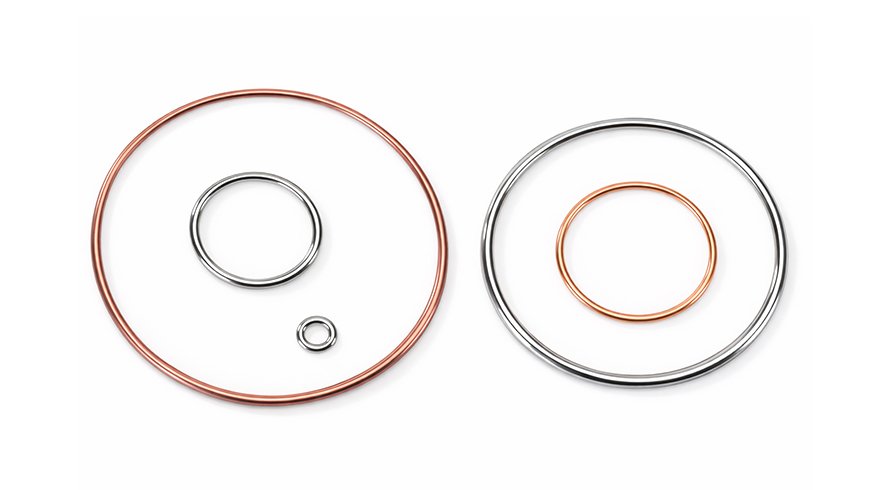
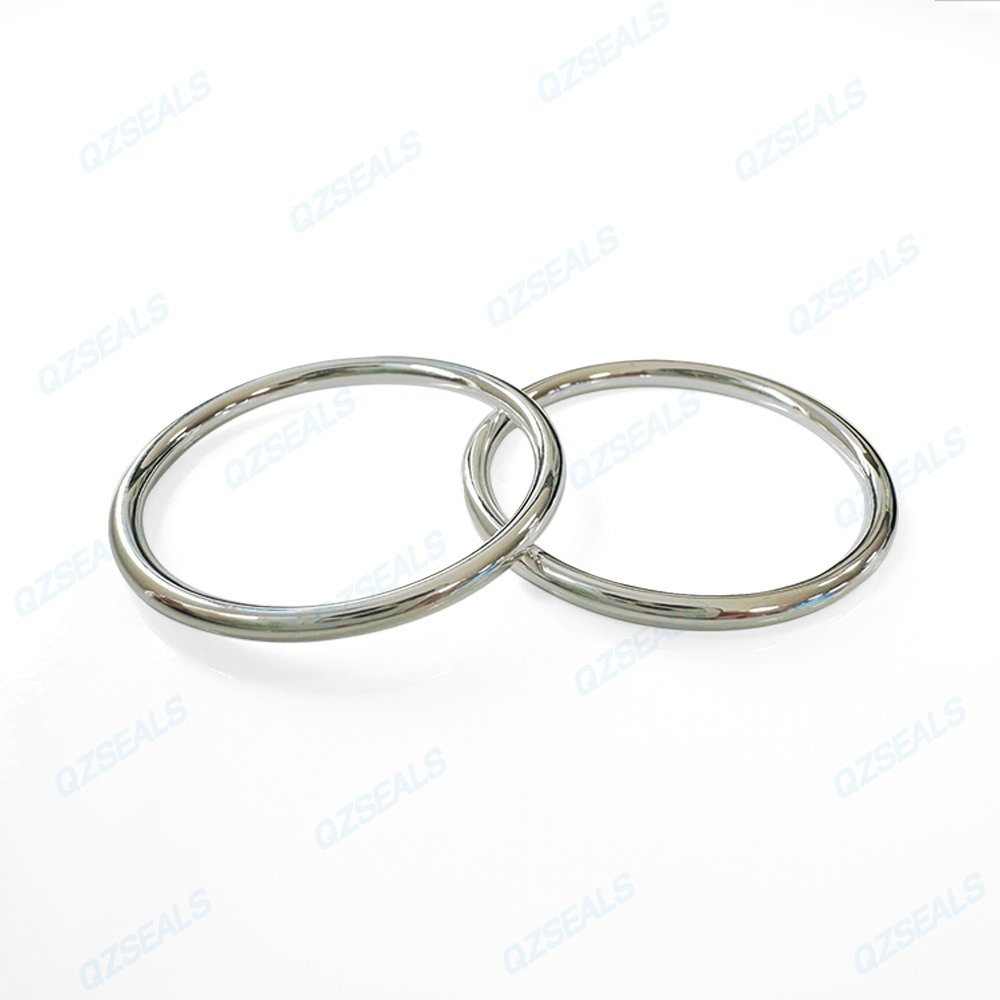
Metal O rings are crafted from precision-formed metal wires, either solid or hollow, through seamless welding or forging. Their design breaks through the physical limits of conventional rubber seals.
Solid section: 1.6–6.35 mm diameter; forms an interference fit in the groove, providing initial contact stress (20–50 MPa).
Hollow tubular section: 0.25–0.5 mm wall; collapses under compression to create a double-line seal with ≥95 % recovery.(See: hollow metal O-ring)
Special cross-sections (Ω, X, etc.): optimized by FEA to enhance creep resistance and pressure uniformity.
Sealing mechanism
Elastic metal deformation ensures nano-level surface contact.
Self-energizing effect: system pressure enhances sealing force proportionally.
Typical parameters
Temperature range: –269 °C to +1000 °C
Pressure resistance: static ≤ 1500 MPa; dynamic ≤ 300 MPa
Leakage rate: ≤ 10⁻¹² Pa·m³/s (ultra-vacuum)
Chapter 2: Through material innovation, metal O rings continue to redefine sealing performance in extreme environments.
The performance of metal O rings evolves alongside advancements in materials science.
High-Temperature Alloys
Inconel 718: Stable up to 700 °C, neutron-resistant, ideal for Gen-IV nuclear reactors.
Hastelloy C-276: Excels in acidic and chlorine-rich environments.
Tantalum-Tungsten Alloys: Resist liquid metal corrosion in fusion reactors.
Surface Technologies
Gold Plating (0.5–2 μm): Reduces friction (μ=0.1) for spacecraft propulsion systems.
Laser-Cladded Ceramics: Surface hardness HV 1500, 10× longer erosion life.
Nanocrystal Strengthening: Grain refinement to 50 nm, tripling fatigue resistance.
Composite Innovations
Metal-Graphite Laminates: Combine metal strength with graphite flexibility.
Dual-Metal Gradient Design: Inner Be–Cu for elasticity, outer titanium for corrosion protection.
At QZSEALS, we select and test every material according to ISO and ASTM standards, ensuring consistent quality for custom applications — from cryogenic to ultra-high-pressure sealing.
Chapter 3: In aerospace applications, metal O rings ensure long-term vacuum sealing reliability.
Nuclear Energy
PWR main pumps: Inconel 690 O-rings perform for 60 years at 15.5 MPa/343 °C.
Sodium loops: molybdenum rings endure 600 °C corrosion with < 1×10⁻⁷ scc/s leakage.
Aerospace
LH₂ tanks: aluminum O-rings retain elasticity at –253 °C.
Space docking: gold-plated stainless steel achieves 10⁻¹⁰ Pa·m³/s vacuum sealing.
Chemical & Energy
Supercritical CO₂ turbines: Ni-based rings run > 80,000 hours at 700 °C/25 MPa. Explore more high-pressure sealing solutions in our Metal Seals Portfolio (internal link: /metal-seals/).
Shale gas wellheads: duplex stainless O-rings resist 20 % H₂S corrosion up to 20,000 psi.
Frontier Technologies
Fusion reactors: tungsten-coated O-rings withstand 1 GW/m² thermal load.
Quantum cooling: Nb-Ti O-rings maintain sealing at 10 mK.
Chapter 4: Challenges and Future Directions
Extreme Environments
ODS alloys enhance ductility > 10 % under 20 dpa radiation.
High-entropy alloys achieve 200 J/cm² impact energy at –269 °C.
Smart Monitoring
Embedded fiber-optic sensors measure strain and residual stress in real-time.
Acoustic diagnostics track micro-cracks, predicting remaining life.
Sustainable Manufacturing
Additive manufacturing (EBM) boosts material yield to 95 %.
Laser micro-texturing replaces coatings, reducing friction by 50 %.
Chapter 5:Selection and Maintenance
Temperature-pressure matching: e.g. Inconel 718 at 600 °C = 70 % of room-temp limit.
Media compatibility: use low-hydrogen-embrittlement alloys (Inconel 625 etc.).
Stress corrosion control: Hastelloy C-22 for > 50 ppm chloride environments.
Inspection: re-polish surfaces with Ra > 0.2 μm; vacuum-anneal at 980 °C for restoration.
Conclusion — The Power of Metal, The Precision of QZSEALS
The metal O rings embodies the perfect union of rigidity and elasticity — a triumph of material engineering.
In environments where polymers fail and pressure exceeds imagination, QZSEALS delivers precision sealing solutions driven by science, experience, and craftsmanship.
From nuclear reactors to spacecraft, from deep-sea turbines to quantum labs, QZSEALS continues to redefine the standards of industrial sealing — ensuring performance that endures where others cannot, our metal O rings represent the ultimate fusion of material science and precision engineering.
QZSEALS – Precision Sealing Solutions for Extreme Applications, for additional technical background on extreme-environment sealing principles, see the engineering guidelines published by NASA Materials & Processes.