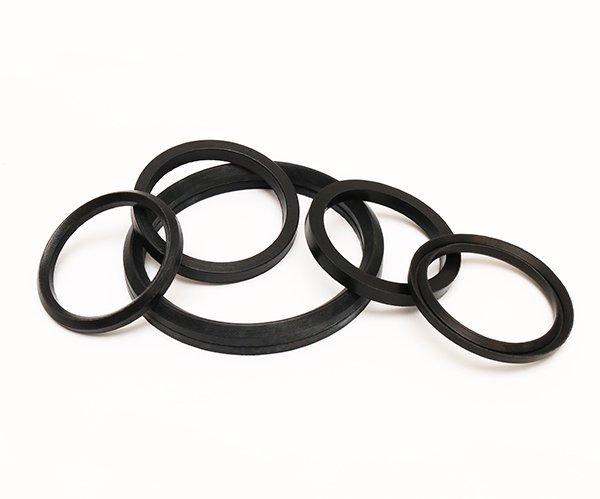



The O ring manufacturing process is a critical series of steps that ensures high-quality, durable seals for industrial applications. An O-ring is a circular rubber seal made of elastomeric material designed to prevent leakage between two mating surfaces, as defined in international sealing standards such as those published by the ISO. Renowned for its excellent elasticity, resilience, and chemical resistance of elastomeric seals, an O-ring maintains reliable sealing performance even under varying pressure, temperature, and environmental conditions. Due to its simplicity, versatility, and cost-effective sealing solutions, the O-ring has become one of the most widely used sealing elements in industries ranging from automotive and aerospace to hydraulics, pneumatics, and general machinery.
Among the various O-ring production methods, compression molding remains the most widely adopted due to its efficiency and suitability for producing standard size rubber O-rings. Depending on application requirements, rubber injection molding and spliced vulcanization are also commonly employed. Each method has its own advantages, ensuring that O-rings of different sizes, shapes, and material specifications for industrial seals can meet diverse operational needs.
As a professional manufacturer of O-rings, QZSEALS is committed to sharing detailed insights into the O-ring manufacturing process. From raw material preparation to the finished product, every step is carefully designed to ensure consistent quality, optimal performance, and long-term reliability. By understanding these processes, customers can better appreciate how high-quality seals are manufactured and why they perform reliably in demanding applications.
Process Outline
Injection Molding – for precision O-ring manufacturing
Spliced Vulcanization – for large-size O-rings
Compression Molding – the main O-ring manufacturing process
Raw Material Preparation (Rubber Mixing)
Mold Design and Making
Semi-Finished Product Preparation (Cutting Strips)
Mold Pressing
Flash Trimming (remove burrs)
Post Curing (Secondary Curing)
Injection Molding – For Precision O-Ring Manufacturing
Injection molding is ideal for high-precision O-rings with complex shapes or tight dimensional tolerances for seals. During the process, rubber is heated, melted, and injected into a mold under high pressure. This method ensures excellent dimensional accuracy, smooth surface finish, and consistent quality, making it particularly suitable for large-scale automated production. In addition, injection molding reduces material waste and allows for the efficient manufacturing of specialized elastomer O-rings such as FKM (Viton) O-rings, silicone, or EPDM.
Spliced Vulcanization – For Large O-Ring Production
For O-rings with an inside diameter exceeding 500 mm, spliced vulcanization for large seals is the preferred technique. In this process, extruded rubber cords like O-Ring Cord are cut to precise lengths and carefully bonded to form a continuous loop. The joint is then vulcanized under high temperature to achieve a strong, seamless connection. At QZSEALS, advanced vulcanization technologies ensure large-size O-rings meet tight dimensional tolerances while maintaining smooth surfaces and consistent mechanical properties. This method is widely used in applications such as industrial pipelines, large hydraulic system sealing, and specialized machinery.
Compression Molding – The Main O-Ring Manufacturing Process
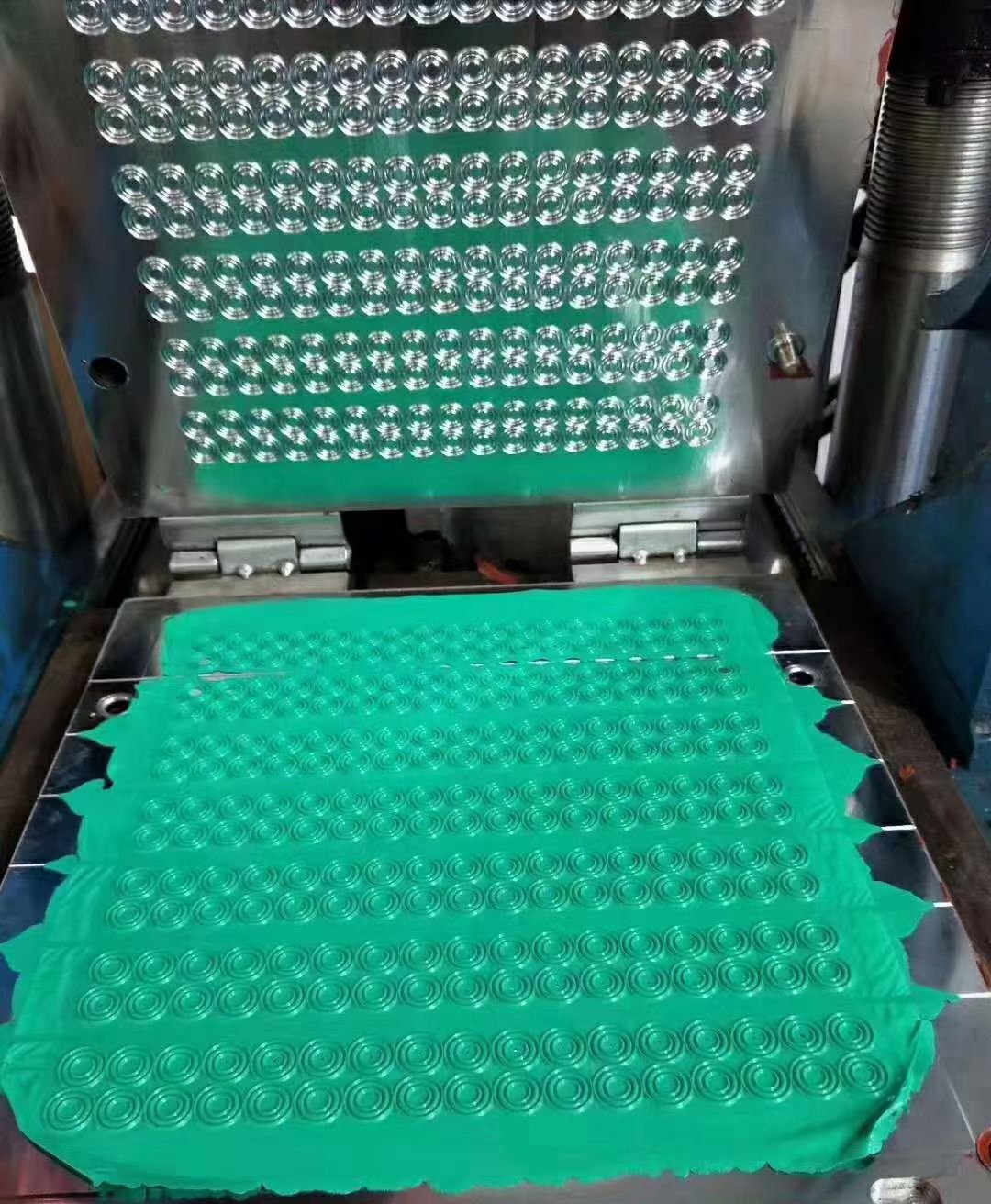
Compression molding is the most efficient and dominant process for O-ring production—covering more than 90% of the market. It is also used for manufacturing square rings, X-rings, gaskets, and custom rubber components.
(1) Raw Material Preparation (Rubber Mixing)
Rubber compounds are mixed to achieve the required plasticity and performance. Proper mixing ensures uniform dispersion of additives, directly influencing product durability.
Open mills are used for small batches, while internal mixers are preferred for higher efficiency and safety.
(2) Mold Design and Making
The mold’s accuracy and surface finish are critical for O-ring sealing quality. Each mold cavity is mirror-polished (Ra ≤ 0.4 μm) and precisely machined to ensure consistent dimensions and long tool life.
(3) Semi-Finished Product Preparation (Cutting Strips)
Rubber is preformed into strips or blanks using precision rubber preforming machines. This improves production efficiency, reduces material waste, and ensures consistent weight for rubber blanks.
(4) Mold Pressing
The rubber vulcanization process requires precise control of temperature, time, and pressure.
Typical curing temperatures range from 145–180°C, depending on the rubber type. Proper control ensures optimal elastomer cross-linking and prevents rubber scorching or under-curing.
(5) Flash Trimming (remove burrs)
After molding, excess rubber (flash) forms along the parting line. Modern cryogenic deburring technology uses liquid nitrogen or CO₂ to freeze and remove flash cleanly, leaving a smooth, precise surface.
(6) Post Curing (Secondary Curing)
Materials like FKM (Viton) or EPDM often require post-curing to enhance hardness, wear resistance, and heat stability.
This secondary heating process ensures complete cross-linking and improved long-term performance.
Conclusion
In summary, there are three main O-ring manufacturing processes—injection molding, spliced vulcanization, and compression molding—with the latter being the most widely used.
Each stage, from material preparation to post-curing, must be precisely controlled to guarantee superior sealing performance and product reliability.
With years of expertise in sealing technology and precision manufacturing, QZSEALS provides durable sealing solutions that help industries reduce mechanical wear, enhance lubrication, and improve industrial energy efficiency.