

Introduction: Clarifying Two of Engineering’s Most Fundamental Components
In the vast lexicon of mechanical engineering, few terms are as fundamental, yet as frequently confused, as seals and gaskets. The topic of seals vs. gaskets is one of the most common sources of misunderstanding in industrial sealing technology. Both are essential for the integrity of countless systems, from automotive engines to complex chemical processing plants. They are the unsung heroes of sealing technology that prevent leaks, contain pressure, and protect sensitive components from contamination.
The common question, “What is the difference between a seal for gasket applications and other types of mechanical seal?” highlights the ambiguity that often surrounds these components. While the terms are sometimes used interchangeably in casual conversation, in a technical context, their meanings are distinct. Understanding this distinction is critical for proper design, maintenance, and operation.
The core of the confusion lies in their relationship: gasket is specific type of seal, but the broader category of seals encompasses a vastly more diverse range of products. In essence, all gaskets are seals, but not all seals are gaskets. This simple statement is the key to unlocking a deeper understanding of sealing technology. Failing to grasp this difference can lead to incorrect component selection, resulting in premature failure, costly downtime, and potential safety hazards.
This definitive guide aims to eliminate this confusion. We will provide clear seal definition and a precise gasket definition, conduct a head-to-head comparison of their functions and designs, and explore their distinct applications. As a global expert in both standard and fully customized mechanical seal and gaskets, QZSEALS is perfectly positioned to illuminate this topic. Our extensive portfolio, ranging from high-quality gasket to advanced hydraulic seal, covers the full spectrum of sealing technology. Join us as we explore the nuances that separate these two critical engineering components.
Chapter 1: Defining the Terms – What is a Seal? What is a Gasket?
TTo build a clear comparison, we must first establish precise, foundational definitions for each term. This starts with understanding the broad, all-encompassing nature of the word “seal.”
The Broad Definition of a “Seal”
Seal, in its most comprehensive sense, are any mechanical seal or device used to close a gap or make a joint fluid-tight. Its purpose is to prevent the unwanted passage of fluids (liquids or gases), contain pressure, or exclude contaminants. This broad definition covers an enormous range of components with varied designs, materials, and mechanisms.
The key takeaway is that the term “seal” is a general category that is defined by its *function*. A seal’s job is to create a barrier. How it achieves this can vary dramatically. This category includes components designed for two fundamentally different types of applications:
- Static Applications: Where there is no relative movement between the two surfaces being sealed.
- Dynamic Applications: Where there is relative movement between the surfaces, which can be rotational (a spinning shaft) or reciprocating (a piston moving back and forth).
Because the definition is so broad, the world of seal types is incredibly diverse. It includes everything from the simple O-ring to the complex, multi-component mechanical seal used in industrial pumps, and from robust piston seal to high-speed oil seal.
The Specific Definition of a “Gasket”
Gasket is a specific and distinct type of mechanical seal. While it serves the same primary function—to prevent leaks—it is defined by its *form* and its specific *application environment*. A gasket is a shaped piece of deformable material that is inserted between two stationary, flat surfaces (flanges) which are then clamped together.
The defining characteristics of a gasket are:
- It is exclusively for static applications. A gasket cannot be used where there is any movement between the mating surfaces.
- It works through compression. The sealing mechanism of a gasket is achieved by applying a clamping force (usually from bolts) that compresses the gasket material. This compression forces the material to flow into and fill the microscopic imperfections on the flange surfaces, creating a tight, continuous barrier.
- It typically covers a large surface area. Gasket is often used to seal the entire interface between two large components, such as a valve cover on an engine or the two halves of a pump housing.
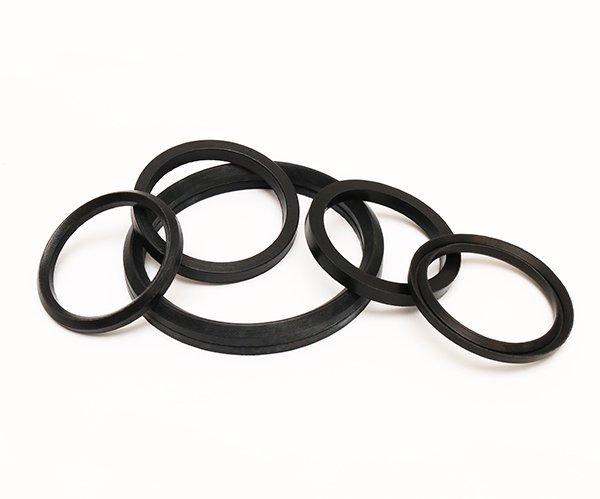
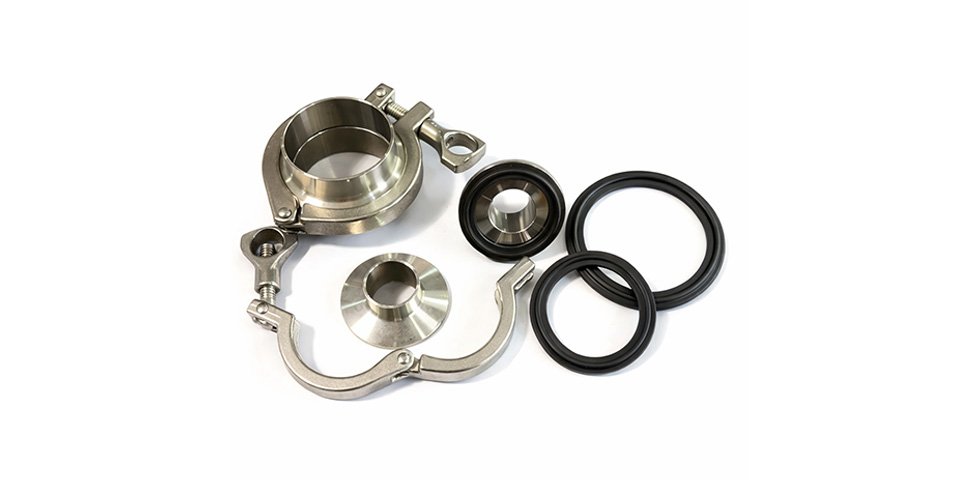
Therefore, when you are looking at a flat, compressible component designed to be sandwiched between two stationary flanges, you are looking at a gasket. Our high-performance PTFE gaskets are a perfect example of this technology, designed for static sealing in chemically aggressive environments.
Chapter 2: The Core Differences: A Head-to-Head Comparison
With clear definitions in place, we can now directly compare seal and gaskets across several key criteria. This comparison will highlight why choosing the right component is so critical.
Application: Static vs. Dynamic Motion
- Gaskets: As defined, gaskets are strictly limited to static applications. Their design is predicated on being held in a fixed, compressed state between two unmoving surfaces. Any movement would quickly lead to fretting, wear, and a loss of the seal.
- Seals: This is the most significant differentiator. The broader category of sealing rings covers both static and dynamic applications. While some sealing rings like O-rings can be used in static face or boss seals (acting much like a gasket, but with a different geometry), many sealing rings are specifically engineered to handle intense movement.
- Reciprocating Seal: rod seal and Piston Seal are designed with flexible lips that maintain contact with a rod or cylinder bore as it moves back and forth.
- Rotary Seal: An oil seal is designed to seal a rotating shaft, often at thousands of revolutions per minute. A gasket in this application would be instantly destroyed.
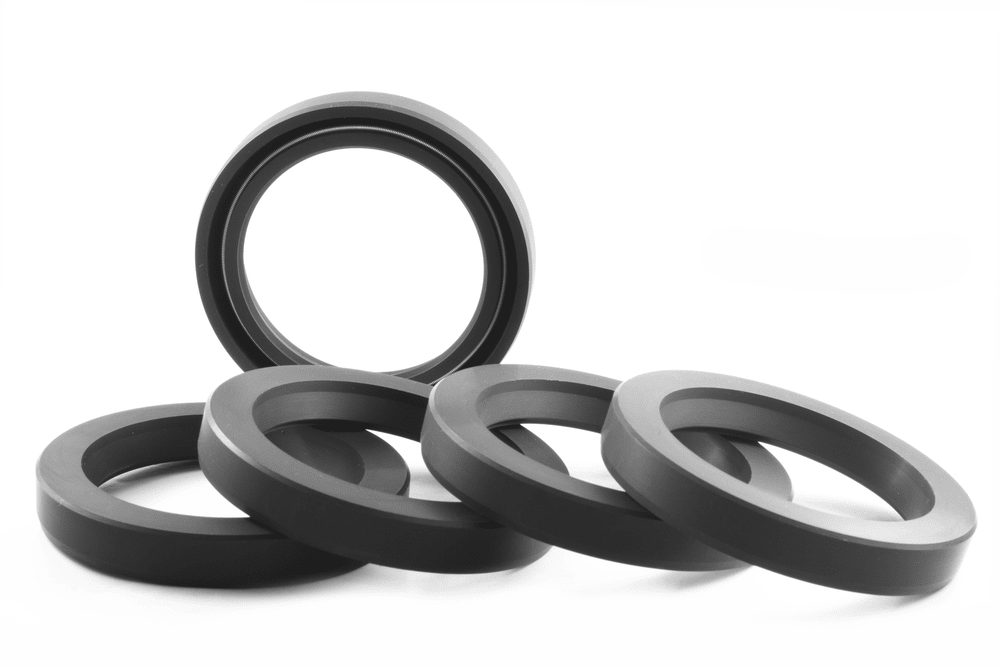
Sealing Mechanism: Compression vs. Diverse Mechanisms
- Gasket: The sealing mechanism is straightforward: high compressive force deforms the gasket material to create a barrier. The quality of the seal is directly related to the applied clamping force and the material’s ability to resist being crushed (creep resistance).
- Seal: The sealing mechanisms are far more varied and sophisticated.
- O-Rings: An O-ring is initially sealed by compression (“squeeze”), but as system pressure is applied, that pressure energizes the O-ring, pushing it against the groove walls and increasing the sealing force. This pressure-assisted sealing is a key advantage.
- Lip Seal: Many dynamic sealing ring (like rod seal and oil seal) use a flexible, pre-tensioned lip. The lip exerts a light radial force on the moving surface. System pressure often acts on the inside of the lip to increase this sealing force, but the design is a delicate balance to minimize friction and wear.
- Spring-Energized Seal: For extreme conditions, spring-energized seal use a metal spring (like a meander spring) to provide a constant mechanical force on the sealing lips, ensuring a seal even when pressure is very low.
Form and Geometry: Flat Profile vs. Complex Cross-Sections
- Gasket: Gasket is almost always characterized by a flat, sheet-like profile. While they can be cut into very complex outlines to match the flange shape, their cross-section is typically simple and uniform.
- Seals: Seal come in a vast array of geometric shapes and complex cross-sections, each optimized for a specific task.
- Toroidal: The simple doughnut shape of an O-ring.
- U-Cup Profile: Common in hydraulic seals, this shape creates flexible lips that respond to pressure.
- Multi-Component Designs: A component like the SPGW piston seal can have multiple parts, including a primary sealing ring, pressure rings, and an energizer, all working together.
- Metallic Rings: metal seals, such as the hollow metal O-ring, have a unique tubular cross-section designed for extreme temperature applications.
Chapter 3: A Deeper Look at Gaskets and Gasket Technology
To fully appreciate their role, let’s explore some specifics of gasket technology, including materials and the often-misunderstood role of gasket sealers.
Common Gasket Materials
Gasket materials are chosen based on their ability to compress and conform without being permanently damaged, and their compatibility with the temperature, pressure, and media of the application. The range of materials is vast:
- Elastomers (Rubber): Materials like Nitrile (NBR) and EPDM are common for general-purpose gaskets in low-pressure applications due to their excellent flexibility.
- Fiber-Based Materials: Compressed non-asbestos fiber (CNAF) sheets are widely used for sealing water, steam, and oils in industrial pipework.
- PTFE: As seen in our range of PTFE gaskets, this material is chosen when exceptional chemical resistance is required. It can handle nearly any industrial chemical, making it ideal for the chemical processing, food, and pharmaceutical industries.
- Metals: For high-pressure and high-temperature applications, solid or composite metal gaskets (like spiral wound gaskets) are used.
Clarifying the Role of “Gasket Sealer”
This is a source of frequent confusion. A gasket sealer or sealant is a chemical compound (a paste, liquid, or spray) that is applied to the surfaces of a gasket or flange. It is not a mechanical component itself. Its purpose is to:
- Fill Minor Imperfections: It can help fill very small scratches or imperfections in the flange surface that the gasket material might not perfectly conform to.
- Act as an Adhesive: In some cases, it helps to hold the gasket in place during assembly, especially in vertical or overhead orientations.
In high-performance industrial applications, the goal is to have flanges that are so well-finished that a gasket sealer is not required. Over-reliance on a sealer is often a sign of a damaged flange or an incorrect gasket choice. A gasket sealer is an aid, not a substitute for a properly selected and installed gasket.
Chapter 4: Exploring the Diverse World of Non-Gasket Seals
The true breadth of sealing technology becomes apparent when we move beyond the static world of gaskets. The non-gasket seals are where engineering innovation shines, solving complex challenges involving motion, pressure, and extreme environments.
Dynamic Seal for Reciprocating Motion
This category is the heart of fluid power (hydraulics and pneumatics). These sealing rings are designed to move back and forth, often millions of times in their service life. A gasket would be completely ineffective here. The system includes:
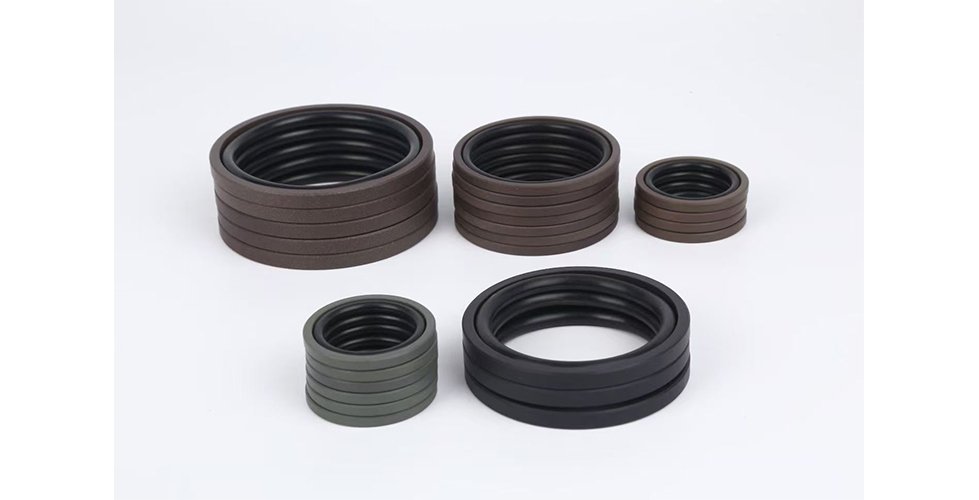
- Piston Seal: These seals, such as our advanced GSF piston seal glyd ring, are mounted on the head of a piston and seal against the cylinder bore. Their complex profiles are designed to allow a microscopic film of oil to lubricate their movement while preventing any significant bypass of fluid.
- Wiper Seal: A wiper seal is a prime example of a specialized dynamic seal. Its sole purpose is to scrape contaminants from a retracting piston rod, protecting the entire internal system. Its sharp, flexible lip is a feature with no equivalent in the gasket world.
Dynamic Seal for Rotary Motion
Sealing a spinning shaft is another major challenge where gaskets cannot be used. This is the domain of the rotary shaft seal, commonly called an oil seal.
- Crankshaft Seal Example: A prime example is the crankshaft seal in an internal combustion engine. This seal must contain motor oil while the crankshaft spins at thousands of RPM.
- How it Works: A typical oil seal consists of a rigid metal case, a flexible elastomeric sealing lip, and a garter spring. The spring provides a constant, light radial force on the lip, holding it against the shaft. The dynamic interface is designed to maintain a thin film of oil (a principle called hydrodynamic lubrication) that both sealing rings and lubricates, minimizing friction and heat.
High-Performance Static Seal That Aren’t Gaskets
Even in static applications, there are superior alternatives to gasket in certain situations. This demonstrates that the choice is not just “gasket for static, other sealing rings for dynamic.”
- O-Rings: For sealing smaller ports or components, an O-ring in a precisely machined groove is often a more reliable and compact solution than a cut gasket. It provides a highly concentrated sealing line and is less prone to relaxation over time.
* Encapsulated O-rings: When sealing aggressive chemicals in a static application, a standard elastomer gasket might fail. An encapsulated O-ring provides the chemical inertness of a PTFE jacket with the reliable energizing force of a rubber core, offering a high-integrity seal in a compact form.
Chapter 5: Making the Right Choice – A Practical Decision Guide
Choosing between a gasket and another type of seal becomes simple when you ask the right questions, which are directly tied to the core differences we’ve discussed.
Choose a Gasket When:
✔ The application is 100% static with no relative motion between the mating surfaces.
✔ The components to be sealed are two relatively large, flat flanges or housings.
✔ The primary sealing force is generated by a high clamping load from bolts or other fasteners.
✔ The operating conditions (temperature, pressure, media) are within the capabilities of available sheet gasket materials.
Choose Another Type of Seal When:
✔ There is any form of movement—reciprocating, rotary, or oscillating. This is a non-negotiable rule.
✔ The sealing area is geometrically constrained, requiring a compact seal to fit inside a machined groove (e.g., an O-ring).
✔ The application requires a low-friction sealing solution for a dynamic surface.
✔ The sealing mechanism needs to be pressure-assisted or spring-energized for optimal performance.
✔ The operating conditions are extreme, requiring the specialized properties of components like metal sealing ring for ultra-high temperatures or spring-energized seal for cryogenic fluids.
Conclusion: A Partnership in Precision Sealing
The distinction between a seal and a gasket is far more than a matter of semantics; it is a fundamental principle of mechanical design. The discussion of seals vs. gaskets highlights one of the most important concepts in industrial sealing technology. The simple takeaway—“all gaskets are seals, but not all seals are gaskets”—serves as a crucial reminder that every application demands a specific solution. When engineers evaluate seals vs. gaskets, they must consider factors such as motion, pressure, and sealing geometry. Gaskets are the masters of static, compressive sealing between flanges, while the broader world of seals offers an incredible diversity of solutions for complex dynamic and high-performance static challenges.
Understanding this difference empowers engineers and technicians to make smarter, more reliable choices, moving beyond a “one-size-fits-all” approach to a strategy of precision and optimization. This is the philosophy that drives us at QZSEALS. We do not just supply parts; we provide engineered solutions. Our comprehensive portfolio covers the entire sealing spectrum, from the highest quality industrial gasket to the most advanced, custom-designed dynamic seal for the world’s most demanding applications.
Our mission is to serve as a reliable industrial partner, offering the technical consultation and innovative products necessary to solve your most critical sealing challenges. Whether your application calls for the steadfast reliability of a gasket or the dynamic performance of a complex hydraulic seal, we have the expertise and technology to ensure your success.