

In the discipline of industrial sealing, design is only half the battle. The most sophisticated geometric profile will fail if the material cannot withstand the operating environment. Temperature extremes, aggressive chemical media, high surface speeds, and abrasive slurries all place severe demands on sealing performance—making advanced sealing materials the true foundation of long-term reliability in modern industrial systems.
QZSEALS distinguishes itself not merely as a manufacturer of sealing geometries, but as an expert in polymer and composite engineering. We understand that seal replacement is often required not because the design concept failed, but because the material degraded under real-world conditions. By focusing on the development and application of advanced sealing materials, from the molecular stability of PTFE to the impact resistance of phenolic resins, our Flexible Sealing Solutions are engineered to resist wear, chemical attack, and thermal aging.
This comprehensive guide explores the advanced sealing materials powering modern industry and the science behind their performance. We examine how different material families interact with pressure, temperature, and motion, and we dissect the role of various types of seals through the lens of chemistry and physics. By doing so, we help engineers and procurement specialists select the optimal compound and material structure for the most demanding industrial applications.
Part 1: Advanced Sealing Materials – The PTFE Revolution (Polytetrafluoroethylene)
PTFE, commonly known as Teflon, fundamentally changed the sealing world. It offers the lowest coefficient of friction of any solid material and near-total chemical inertness, making it a cornerstone of modern PTFE sealing solutions for chemical, pharmaceutical, and high-speed industrial applications. However, PTFE also has a well-known weakness: “cold flow,” or creep, which can limit its performance under sustained load and pressure.
At QZSEALS, we engineer PTFE to overcome this limitation. Through material modification, precision machining, and profile optimization, our PTFE sealing solutions are designed to resist creep, maintain dimensional stability, and deliver consistent sealing performance in demanding operating environments.
Virgin vs. Filled PTFE
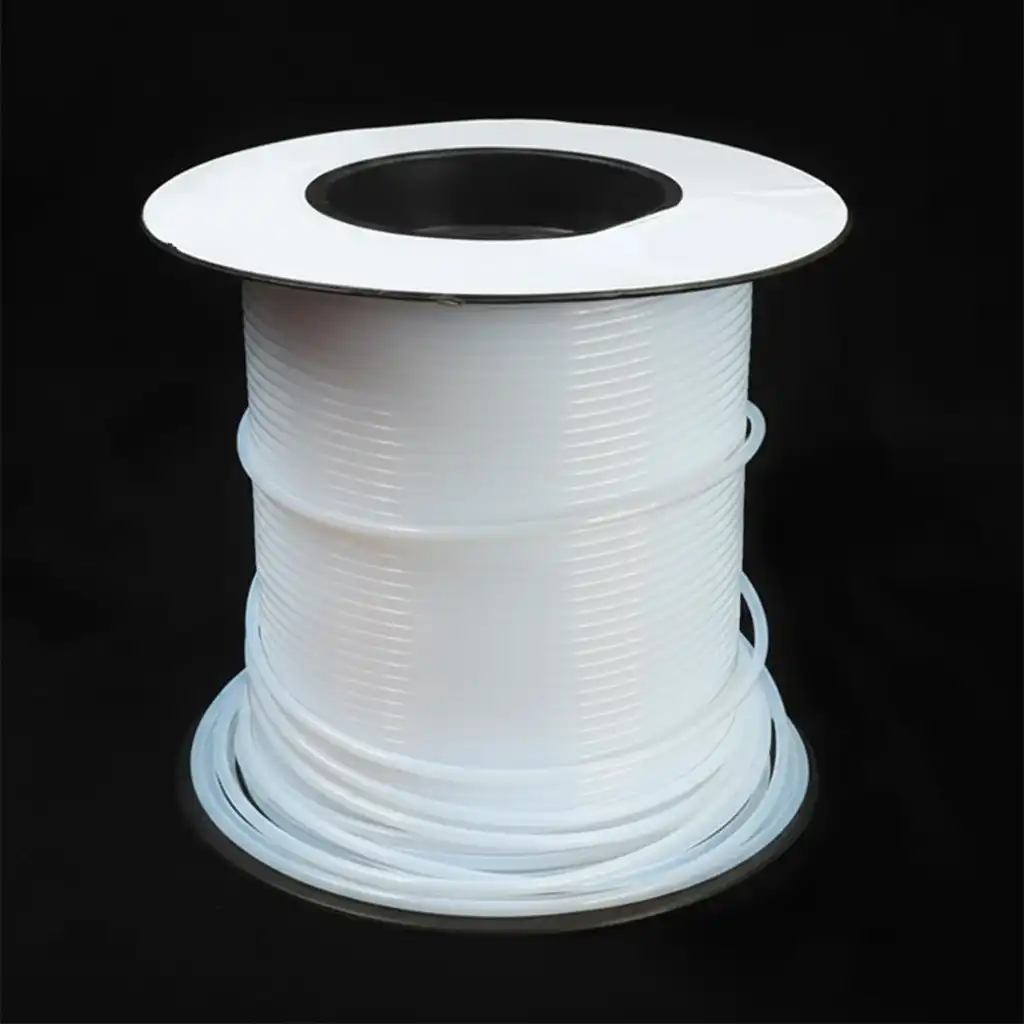
Virgin PTFE is excellent for static applications like chemical resistance gaskets. We supply PTFE Cord and PTFE Gaskets for flanges in pharmaceutical and acid processing plants where purity is paramount.
However, for dynamic hydraulic applications, virgin PTFE is too soft. We add fillers to enhance its properties:
- Bronze Filled: The PTFE Filled Bronze Guide Tape is the industry standard for guiding pistons. The bronze increases compressive strength and thermal conductivity, dissipating heat away from the seal interface.
- Carbon/Graphite Filled: Used in rotary applications where water is present, or lubrication is poor.
PTFE in Rotary Motion
Standard rubber oil seals burn up at high surface speeds. Our PTFE Oil Seals with Stainless Steel cases bridge the gap. They can run dry, withstand aggressive oils, and operate at speeds far exceeding NBR or FKM capabilities.
Part 2: Heavy-Duty Composites for Hydraulics
In sectors like mining and earthmoving, hydraulic cylinders face massive side loads. If the piston touches the cylinder bore, catastrophic scoring occurs. Standard plastic guides are insufficient; we need composites.
Phenolic Resins and Fabric Reinforcement
QZSEALS utilizes thermosetting resins reinforced with fine fabric meshes. This creates materials with immense compressive strength.
- Wear Rings: The Phenolic Resin with Fabric Wear Ring is designed to absorb radial loads while embedding abrasive particles that would otherwise damage the hardware.
- Guide Tapes: For flexibility in installation, phenolic resin with fabric guide tape can be cut to size for any cylinder diameter.
Multi-Material Piston Seals
The best seals combine materials. The SPGW Piston Seal is a prime example. It uses a PTFE face for low friction, a rubber energizer for static sealing, and POM (Polyacetal) back-up rings to prevent extrusion. This synergy allows it to handle the extreme pressure spikes found in excavators.
Part 3: Spring Energized Geometries
What happens when the environment is too cold for rubber to stay flexible, or so hot that it takes a compression set? We replace the elastomer’s “memory” with a metal spring. This is the spring energized seal.
The Mechanics of Spring Force
The jacket is typically made of Modified PTFE or UHMWPE, while the spring provides the load.
- Helical Springs: The helical spring provides a high, concentrated load. It is ideal for static or slow-moving applications where gas-tight sealing is required, such as in vacuum systems.
- Meander (Cantilever) Springs: The meander spring offers a linear load curve with high deflection. This makes it perfect for dynamic rod seals where runout or misalignment is present.
Metallurgy Matters
The spring material must resist the environment. We primarily use stainless steel 301 helicoil springs for general corrosion resistance. For sour gas (H2S) or medical applications, specialty alloys like Elgiloy are used.
These seals are critical components in dispensing machines for adhesives and paints, where chemical compatibility is the main challenge.
Part 4: High-Performance Polymers (PEEK & Polyurethanes)
Beyond rubber and PTFE, engineering plastics play a vital role.
PEEK in Compressors
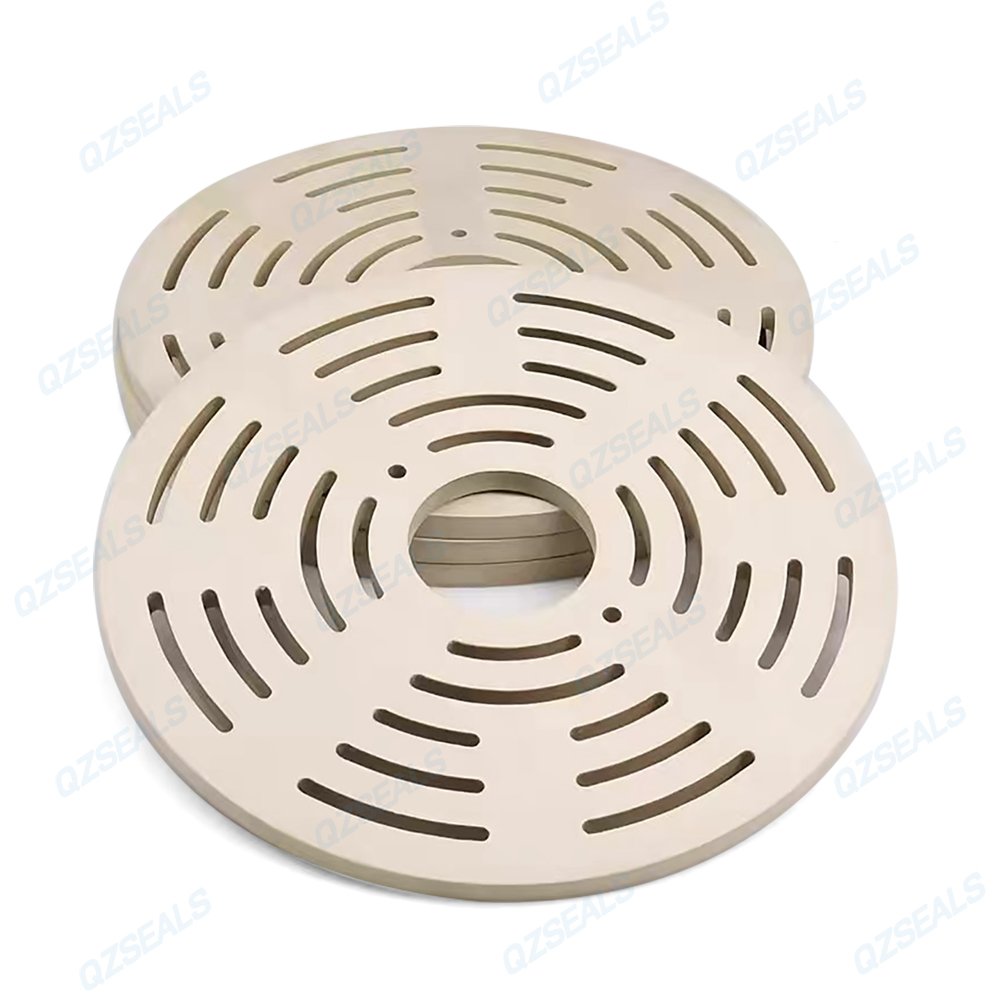
Polyetheretherketone (PEEK) is a high-performance thermoplastic with exceptional mechanical properties at elevated temperatures, making it one of the most reliable materials for demanding PEEK applications in industrial machinery. In the compressor industry, where components are subjected to continuous cyclic loading, traditional metal valve plates often fail prematurely due to metal fatigue.
QZSEALS manufactures the PEEK valve plate. It is lighter, quieter, and significantly more resistant to impact fatigue than steel, extending the service interval of the compressor.
Polyurethane (PU) in Hydraulics
For abrasion resistance, nothing beats Polyurethane. Our IDI rod seal and UNS piston rod seal utilize high-grade PU to resist the wear and tear of rapidly stroking cylinders.
Part 5: Fluid Handling Seals and Pump Sealing
Pumps handling slurries, chemicals, or food products require specialized sealing strategies. Leaking pumps are a major source of industrial waste.
Gland Packing: The Traditional Workhorse
For stuffing boxes, braided packing remains a reliable solution.
- Abrasive Media: In mining slurries or paper pulp, aramid fiber gland packing (often known as Kevlar) provides immense tensile strength and abrasion resistance.
- High Heat/Speed: high pressure graphite gland packing dissipates heat rapidly and is self-lubricating, protecting the pump shaft from damage.
Diaphragms and Valves
In dosing pumps, the seal is a flexible membrane. The fabric reinforced rubber diaphragm must flex millions of times without cracking. We reinforce elastomers with nylon or polyester fabric to ensure longevity.
For flow control, precision is key. We supply PET balls for check valves, offering a lightweight, chemical-resistant alternative to metal spheres.
Part 6: Customization and Extreme Engineering
Standard catalogs cannot cover every innovation. QZSEALS excels in bespoke Customized Rubber Seals.
Inflatable Seals
For airlocks, dome valves, and cleanroom doors, a static gasket is not enough. custom inflatable seals expand with air pressure to close large, uneven gaps, creating a hermetic barrier on demand.
Metal Sealing for Ultimate Heat
When the temperature exceeds 300°C, even PEEK and PTFE degrade. We turn to metal sealing rings. The hollow metal O-ring is a gas-filled or vented metal tube that seals through the plastic deformation of its plating (silver, nickel) and the elasticity of the tube substrate.
Part 7: Everyday Essentials – O-Rings and Gaskets
Even simple seals benefit from material science.
Advanced O-Ring Solutions
While we produce millions of standard O-ring rubber seals, we also solve chemical compatibility issues. The FEP encapsulated O-ring is a “problem solver” seal, allowing standard gland designs to be used in aggressive chemical lines.
Gasketing
For low-pressure oil sealing, the Red Steel Paper Gasket remains a cost-effective, reliable choice. For steam and high-pressure fluids, Oil Resistant Asbestos Gaskets (where permitted) or non-asbestos equivalents are used.
Conclusion
The difference between a machine that runs for years and one that leaks weekly often comes down to material selection and the proper application of industrial sealing technology. Whether it is the creep resistance of PTFE, the fatigue life of PEEK, or the elasticity of a silicone membrane, QZSEALS has the expertise to guide your choice.
We invite you to explore our advanced sealing material capabilities. From rod seals to complex mechanical seals, QZSEALS delivers the material science necessary for global industrial success.