

In the industrial world, the cost of industrial seals is negligible compared to the cost of the machine it serves. Yet, the cost of a failed seal is astronomical. A $5 seal can halt a $500,000 production line. Therefore, the selection process is not just a purchase; it is a strategic engineering decision. This selection guide helps engineers navigate the complex landscape of sealing solutions and make informed choices. For detailed material and engineering specifications, refer to the ASTM Standards for comprehensive guidelines on seal materials, testing, and performance.
QZSEALS understands that “good enough” is rarely sufficient in critical applications. As a global manufacturer, we witness the consequences of poor specification daily: extrusion, stick-slip, and catastrophic leakage. Our mission is to provide clear engineering specifications and guidance to OEMs and maintenance teams, ensuring they choose the optimal solution.
This guide serves as a comparative analysis. We will pit different types of seals against each other—comparing profiles, materials, and mechanisms—to help you navigate the QZSEALS catalog and select the precise component for your application.
Part 1: The Selection Framework (STAMPS)
Before browsing the catalog, every engineer should apply the STAMPS method. This ensures no critical variable in sealing solutions is overlooked.
- S (Size): Rod and bore diameter, groove width. Custom sizes like the Custom L2M Oil Seal are needed when standards don’t fit.
- T (Temperature): Cryogenic cold requires Helical Springs. Extreme heat requires Metal Sealing Rings.
- A (Application): Is it dynamic (piston/rod) or static (flange)?
- M (Media): Is the fluid compatible with NBR rubber, or do you need an FEP Encapsulated O-Ring?
- P (Pressure): High pressure dictates seals with anti-extrusion rings like the SPGW Piston Seal.
- S (Speed): High speed requires low friction materials like PTFE.
Part 2: Piston Seal Showdown – Robustness vs. Efficiency
The piston seal drives the force. Choosing the right profile involves a trade-off between load-holding capability and friction.
Option A: The Heavy Lifter (SPGW)
Best for: Excavators, cranes, and heavy presses.
The SPGW Piston Seal is a composite design. It features a PTFE face for sliding, a rubber energizer for sealing, and two polyacetal back-up rings.
Pros: immense resistance to extrusion; high load capacity.
Cons: Higher friction than simple O-rings; requires a split piston for easy installation.
Option B: The Friction Fighter (Glyd Ring)
Best for: Robotics, servo-hydraulics, and high-speed cylinders.
The GSF Piston Seal Glyd Ring uses a simple PTFE ring energized by an O-ring.
Pros: Ultra-low friction; no “stick-slip” effect; compact groove.
Cons: Less robust against massive shock loads than the SPGW.
Option C: The Compact Solution (SPG & KR)
Best for: General industrial cylinders with limited space.
The SPG piston seal and the double-acting KR piston seal integrate all functions into a small profile. They are excellent for standard pneumatics and light hydraulics.
Part 3: Rod Seal Strategy – Preventing the Leak
Rod seals are the most critical for environmental safety. The choice is often between a single high-performance seal or a tandem sealing system.
The Primary Barrier: Step Seals
The GSJ seal step seal is designed to pump oil back into the cylinder on the return stroke.
Why choose it? It handles high pressure spikes without blowing out. It is the preferred choice for the “primary” seal in a tandem system.
The Secondary Barrier: U-Cups
The IDI rod seal and UNS piston rod seal act as the final defense.
Why choose it? The U-cup design provides a tight static seal at low pressures. It ensures that the microscopic oil film let past the Step Seal is finally stopped.
The Compact Alternative
For small cylinders where you cannot fit two seals, the S8 rod seal combines the functions. It is a robust, single-piece solution for mobile hydraulics.
Part 4: Wiper Seal Selection – Metal vs. Rubber
The wiper protects the entire system. Don’t overlook it.
- Snap-In (Flexible): The GPTA Wiper Seal is easy to install and works well in closed grooves. It prevents dust ingress.
- Press-Fit (Rigid): The DKBI dust seal has a metal case. It is designed for open grooves and harsh environments (mud, ice) where a rubber wiper might be pulled out of the housing by sticky debris.
Part 5: Rotary Seal Decisions – Oil and Speed
Sealing a rotating shaft requires balancing heat generation with leak prevention.
Standard Rubber (TC) vs. PTFE
Scenario 1: Standard gearbox, speed under 10m/s, moderate temp.
Choice: TC oil seal. It is cost-effective and reliable.
Scenario 2: High-speed motor, chemical mixer, or dry running.
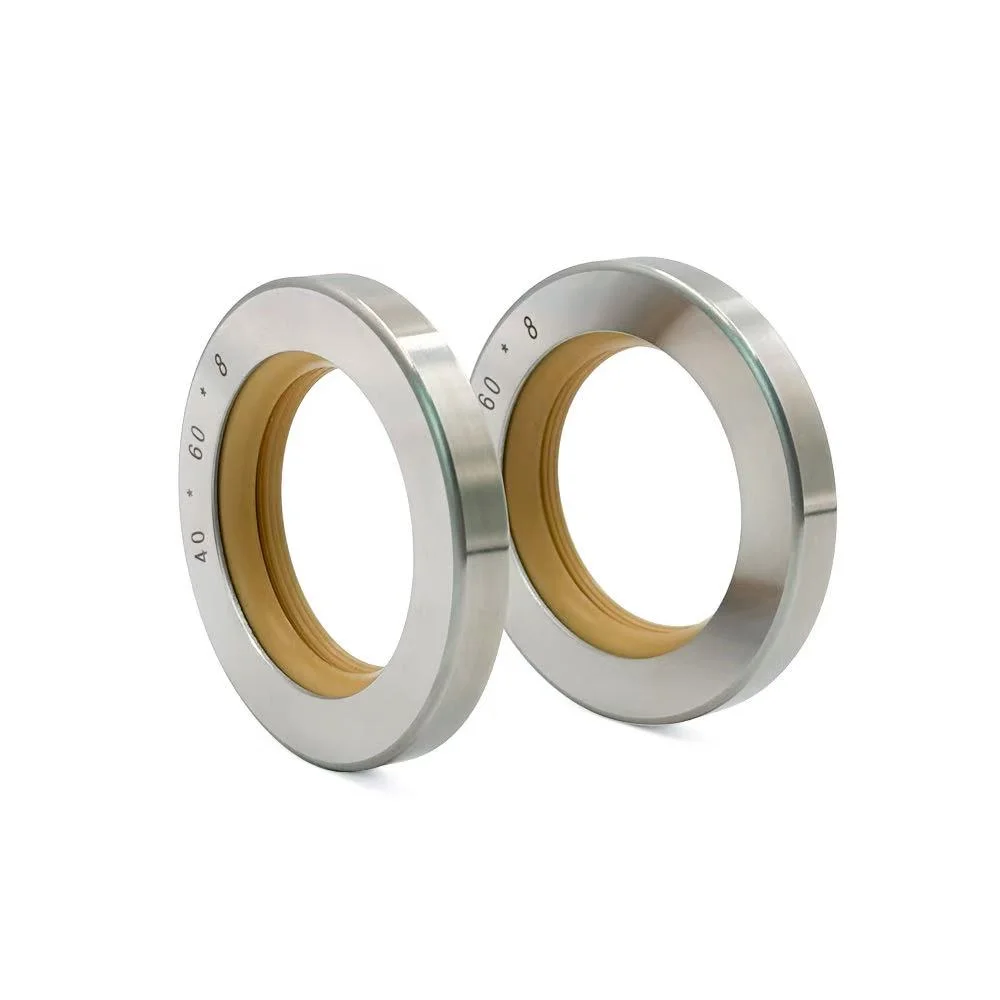
Choice: PTFE oil seal with stainless steel. Rubber would burn or crack here. PTFE stays slick and cool.
Adding a Slinger
Regardless of the main seal, adding a V-Ring is a cheap insurance policy. The VA ring rotates with the shaft and flings water and dust away, protecting the main seal from contamination.
Part 6: Static Sealing – Gaskets vs. O-Rings
How do you seal a flange? It depends on the surface finish and pressure.
The O-Ring Advantage
In a machined groove, an O-ring rubber seal is capable of holding immense pressure. For massive flanges where a molded ring is impossible, an O-ring cord can be vulcanized to size.
The Gasket Solution
For flat, potentially uneven surfaces (like an oil pan), gaskets are superior.
- Automotive: red steel paper gaskets swell slightly to seal imperfect surfaces.
- Industrial Piping: oil resistant asbestos gaskets (or non-asbestos) provide structural rigidity for bolted flanges.
- Chemical: PTFE gaskets are non-stick and chemically inert.
Part 7: Advanced Technologies for Special Cases of Industrial Seals
When the standard chart says “impossible,” look here.
Spring Energized Seals
For applications like dispensing machines where glues ruin rubber, or in cryogenics, use spring energized seals.
Selection: Use a helical spring for static vacuum sealing and a meander spring for dynamic reciprocating motion.
Metal Seals
If the temperature exceeds 300°C, polymer seals die. The hollow metal O-ring is the nuclear option—literally often used in nuclear and aerospace applications.
Pneumatic Optimization
Don’t use hydraulic seals for air; friction will be too high. Choose the Z8 pneumatic seal, which is designed with a light-load lip for air systems. Pair it with buffer seals to dampen the end-of-stroke impact.
Conclusion: Consulting the Experts
The “best” seal is not the most expensive one; it is the one that fits the application parameters perfectly. Using a heavy-duty hydraulic seal in a high-speed pneumatic cylinder is a recipe for failure, just as using a standard O-ring in a chemical line is dangerous.
QZSEALS offers the breadth of product—from wear rings to gear pump seals—and the depth of engineering knowledge to help you make these choices. We encourage you to use this guide and seal types comparison as a starting point and contact our technical team for a detailed consultation.
Explore our full range of rod seals, piston seals, and O-rings to find the exact component your project demands.